No products in the cart.
Return To Shop0 Days
0 Hours
0 Mins
0 Secs
XStore is the Most Customizable & WooСommerce Theme Shop Now

11,99 €
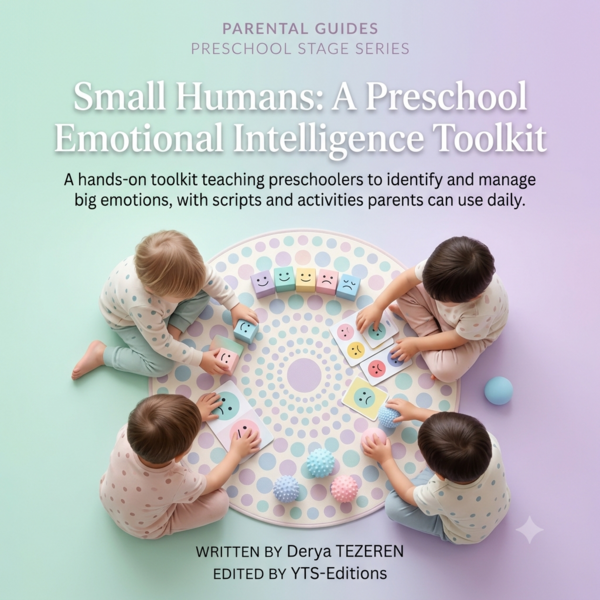
The shoe won’t go on right. The tower fell down. A sibling looked at them “wrong.” And suddenly you have a small person on the floor, sobbing with an intensity that seems wildly disproportionate to what actually happened — because it is, and also, from inside their still-developing brain, it isn’t. Preschoolers feel everything at full volume. Joy, disappointment, frustration, embarrassment — it all arrives at maximum intensity, with almost none of the vocabulary needed to name it, process it, or communicate it calmly.
Big Feelings, Small Humans was built to give both of you that vocabulary.
This is a genuinely hands-on toolkit — not a philosophy book about the importance of emotional intelligence, but a practical set of tools you can start using in daily moments, not just during meltdowns. Emotional intelligence isn’t innate. It’s taught, one small moment at a time, and this toolkit gives you the exact tools to teach it, starting today.
It’s tempting to think some kids are naturally more emotionally regulated than others — and temperament does play a real role. But the deeper truth is that emotional intelligence is a learnable set of skills: recognizing a feeling, naming it accurately, understanding what triggered it, and finding a way to move through it. None of that is automatic. All of it can be actively taught, the same way you’d teach any other developmental skill — with repetition, modeling, and the right tools at the right moments.
This toolkit gives you those tools across every part of daily life — not just the crisis moments, but the calm ones too, where most of the real teaching actually happens.
Why Emotional Intelligence Starts Now. A grounding opening chapter making the case for starting emotional literacy work in the preschool years specifically — why this window matters, and why waiting until “they’re old enough to understand” actually means missing the most receptive developmental period for building this foundation.
Building an Emotion Vocabulary. Age-specific vocabulary-building activities for three, four, and five-year-olds, giving your child an expanding, precise language for what they’re feeling — because a child who can say “I’m frustrated” instead of simply screaming has already taken a meaningful step toward regulation.
The Daily Feelings Check-In. A simple, repeatable daily routine template that builds emotional check-ins into ordinary life — not a big production, just a small, consistent habit that normalizes talking about feelings before they escalate into a crisis.
Setting Up a Calm-Down Corner. A complete, no-special-products-needed guide to creating a dedicated calm-down space at home — what actually belongs there, how to introduce it to your child, and how to use it as a genuine regulation tool rather than a time-out in disguise.
Validating Without Over-Giving-In. One of the most requested and most misunderstood parenting skills: how to genuinely validate your child’s big feelings without automatically capitulating to every demand attached to them. This chapter gives you specific scripts for holding both truths at once — “your feeling is real” and “the answer is still no.”
Teaching Empathy With Siblings and Peers. Practical activities for building empathy and perspective-taking in the context of sibling and peer relationships — turning everyday conflicts into genuine teaching moments instead of just problems to referee.
Handling Big Feelings in Public. Specific strategies for the moments that feel highest-stakes — a meltdown at the grocery store, a public tantrum in front of judgmental strangers — so you can respond to your child’s actual needs instead of your own social discomfort.
When Feelings Signal Something More. Honest, clear guidance on distinguishing typical preschool emotional intensity from patterns that might benefit from additional support — so you’re never left wondering whether what you’re seeing falls within a normal range.
Modeling Emotional Regulation Yourself. A chapter grounded in a simple but often overlooked truth: your own visible emotional regulation is one of the most powerful teaching tools available. Practical guidance for modeling the exact skills you’re trying to teach, even on your own hardest days.
Your Family’s Emotion Toolkit Recap. A condensed, practical summary bringing every tool in this guide together — vocabulary-building, check-ins, the calm-down corner, validation scripts — into one at-a-glance reference for your family’s ongoing emotional toolkit.
This guide is for parents of preschoolers three to five years old, across any parenting style, who want to actively support their child’s emotional and social development. It’s for the parent standing in the grocery store during a meltdown, wishing they had the right words in that exact moment. It’s for the parent who wants to raise a child who genuinely understands their own big feelings — not just one who’s been taught to suppress them. And it’s for anyone who suspects, correctly, that emotional intelligence is a skill worth investing in as intentionally as any academic one.
Most emotional-intelligence content for parents stays theoretical — explaining why emotional literacy matters without giving you much to actually do about it. Big Feelings, Small Humans is built the opposite way: genuinely practical, genuinely usable, requiring no special products or elaborate setups. Every chapter gives you something concrete — a script, an activity, a routine template — designed to fit into ordinary daily life, not add another complicated system to manage.
This is a toolkit in the truest sense: pick it up, use exactly the tool you need for the moment you’re in, and put it back down until next time.
Your preschooler’s big feelings aren’t a behavior problem to correct. They’re a skill still under construction — and with the right tools, used consistently in the small, ordinary moments of daily life, you can genuinely help build it.
Download Big Feelings, Small Humans now and get your complete emotional intelligence toolkit for the preschool years.
Instant digital download. Lifetime access. Keep it close at hand — this toolkit is built to be used in the actual moment a big feeling shows up, again and again, for years to come.









Reviews
There are no reviews yet.